

Skip to content

Cart

Your cart is empty

 Temperature Guide 

 Bosideng Warmth Guide 

Everyone experiences the cold differently. Our Warmth Guide is designed to help you choose down outerwear for the conditions you will actually be wearing it in, from a mild spring evening to a long day outdoors in deep winter. 

Each style is assigned one of seven Warmth Levels, based on how the garment is built rather than on a single number. You will find the Warmth Level on every down product page.

The Scale  

Seven Warmth Levels

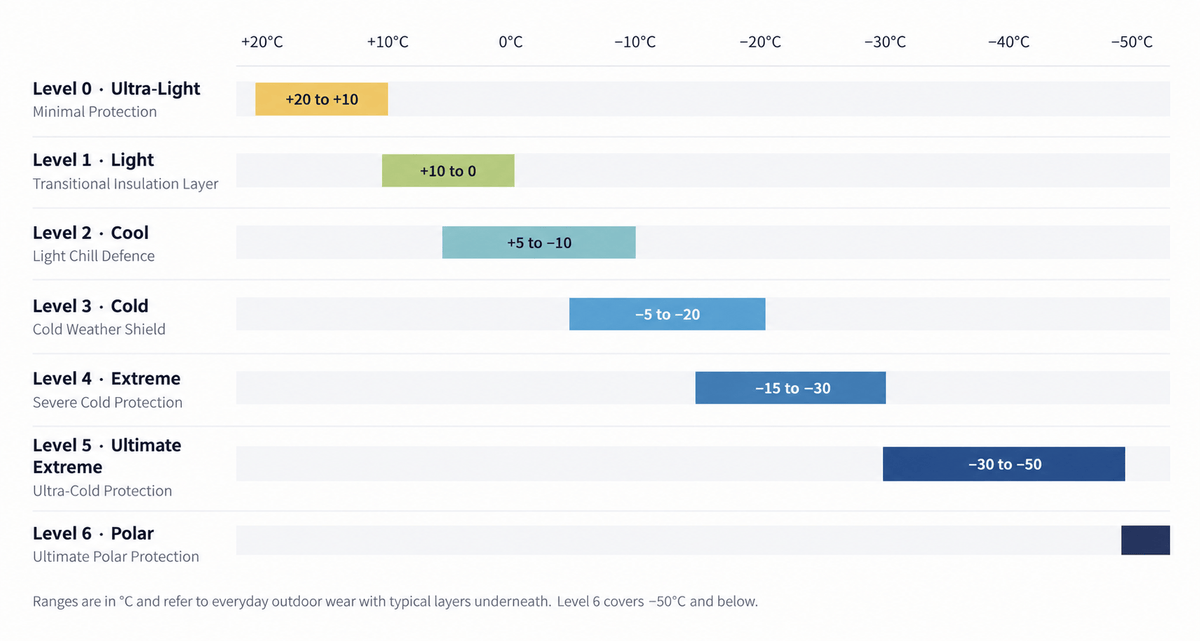
Each level shows a recommended temperature range for everyday wear. Neighbouring ranges overlap on purpose: the right choice within an overlap depends on how long you will be outside, how active you are and how you layer.

Warmth Guide

What each level is designed for

The scenarios below are examples to help you picture each level. They are a starting point, not a limit.

  • Level 0

    +10°C to +20°C50°F to 68°F

    Ultra-Light

    Minimal protection

    Designed for

    Spring and summer conditions. A lightweight outer layer that offers wind protection and sun coverage, with little to no insulation.

    Typical scenarios

    Breezy spring days, summer evenings, travel and holidays where a packable layer is useful.

  • Level 1

    0°C to +10°C32°F to 50°F

    Light

    Transitional insulation layer

    Designed for

    Transitional seasons and layering. Light insulation for mild and changing conditions.

    Typical scenarios

    Autumn and early spring, cool mornings, wearing indoors, or as a mid-layer under a shell or a warmer coat.

  • Level 2

    −10°C to +5°C14°F to 41°F

    Cool

    Light chill defence

    Designed for

    Cool weather. Reliable warmth for early winter and cold city environments.

    Typical scenarios

    Daily commuting in late autumn and early winter, city walks, short waits outdoors on chilly days.

  • Level 3

    −20°C to −5°C−4°F to 23°F

    Cold

    Cold weather shield

    Designed for

    Cold winter conditions. Dependable insulation for daily wear in sustained cold.

    Typical scenarios

    Midwinter commutes, longer periods outdoors in freezing weather, winter city breaks to colder destinations.

  • Level 4

    −30°C to −15°C−22°F to 5°F

    Extreme

    Severe cold protection

    Designed for

    Severe cold and prolonged outdoor exposure, where enhanced insulation is needed.

    Typical scenarios

    Deep-winter travel to northern regions, extended time outdoors in harsh cold, après-ski and winter sightseeing.

  • Level 5

    −50°C to −30°C−58°F to −22°F

    Ultimate Extreme

    Ultra-cold protection

    Designed for

    Extremely cold conditions, using enhanced insulation and construction. Intended for specialised use rather than everyday city wear.

    Typical scenarios

    Travel to sub-arctic regions in winter and long periods of low activity in intense cold.

  • Level 6

    −60°C to −50°C−76°F to −58°F

    Polar

    Ultimate Polar Protection

    Designed for

    Extreme and polar environments, offering our highest level of insulation and protection.

    Typical scenarios

    Polar and high-latitude environments. Reserved for a small number of dedicated styles.

 Our Method

 How we assign a Warmth Level

Warmth comes from the whole garment, not just one specification. We look at the following together when rating each style, and we deliberately take a conservative view.

 Down type 

Goose down and duck down have different cluster characteristics, which affect how they insulate.

 Fill power  

Fill power indicates how much loft the down provides. Higher fill power traps more warm air for the same weight of down.

Fill weight 

The amount of down in the garment. Together with fill power, it determines how much warm air the insulation can hold.

 Length and silhouette 

Gilets, jackets and longer parkas cover the body differently, which changes how warm they feel in the same conditions.

Shell fabric 

Wind-resistant and water-resistant outer fabrics help the insulation keep its warmth in real outdoor conditions.

 Lining and construction 

Heat-retaining linings and protective details such as hoods and higher collars are also taken into account.

 Your Comfort

 Why your experience may differ

Temperature ranges are a guide. How warm you feel on the day also depends on:

Individual perception

Some people naturally feel the cold more than others. If you tend to feel cold, consider the next level up.

Layering

What you wear underneath makes a real difference. A warm mid-layer can extend the range of a lighter coat.

Activity level 

Walking briskly generates heat; standing still at a bus stop or watching an outdoor event does not.

Wind and humidity 

Wind and damp air can make conditions feel considerably colder than the temperature on the forecast.

Time outdoors 

A ten-minute walk and a full afternoon outside call for different levels of warmth.

Fit 

A fit that leaves room for layers, without large gaps at the hem and cuffs, helps keep warm air in.

 FAQ 

 Need help choosing? 

Tell us where and how you will wear it, and our team will be happy to recommend a style.